At one of the world’s largest beverage production networks, water quality monitoring is business critical. Water is the primary raw material used across production, making rapid microbiological insight essential for operational continuity and product protection.
The situation
The Challenge
The site faces recurring variability in the microbiological quality of incoming municipal water. This creates uncertainty, particularly in beverage production where water is the primary raw material, as routine microbiological testing requires extended analysis time before results are available.
Traditional compendial microbiology methods required 5-7 days to generate results, limiting the team’s ability to react quickly to changes in water quality and increasing the risk of delayed corrective actions.an days by applying rapid growth-based microbial testing.
The Solution
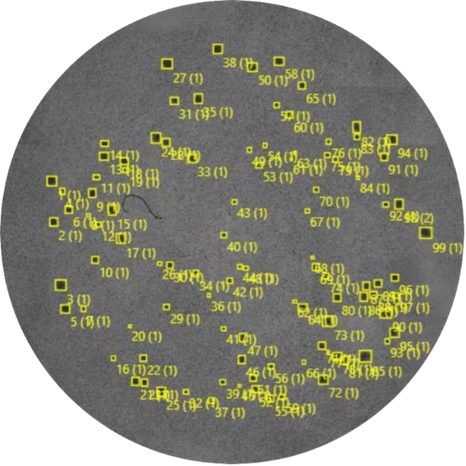
Using the IntuGrow rapid microbiology platform, together with our vacuum filtration workflow, the customer implemented routine rapid bioburden monitoring for both incoming raw water and treated process water.
The method enabled filtration of sample volumes up to 100 mL while maintaining a practical and scalable workflow for daily operations.
The uncertainty window
Every hour between sampling and result is an hour of production running on assumption, not data. Here’s what closing that window looks like.
Uncertainty Window: Traditional vs IntuGrow
Contamination status unkown untill day 5
Day 0
Day 1
Day 2
Day 3
Day 4
Day 5
Same shift corrective actions possible
Day 0
Day 1
Day 2
Day 3
Day 4
Day 5
IntuGrow Uncertainty Window
Results available within the same working shift as sampling. Quality and production teams can evaluate water status, trigger corrective actions, and adjust processes before the next cycle begins.
Traditional uncertainty window
Production continues for 5-7 days with no confirmed knowledge of incoming water quality. Batch decisions, treatment adjustments, and corrective actions are all delayed compounding quality risk with every passing shift. Teams must act on assumptions rather than data.
The outcome
Results
- Reduced microbiological time to detection from several days to as little as 3-24 hours, enabling production and quality teams to assess water conditions and respond within the same working shift.
- Routine processing of up to 100 mL water samples using vacuum filtration.
- Faster operational decision-making following each analysis cycle.
- Expanded deployment across additional manufacturing sites.